
Zuckerberg Tells a Truth

W.J. Astore

Ready for Your AI “Friends”?

I caught this snippet from Mark Zuckerberg, guru of Facebook:

There’s this stat that I always think is crazy. The average American, I think has, I think it’s fewer than three friends, three people that they’d consider friends and the average person has demand for meaningfully more. I think it’s like 15 friends or something.

If you’re familiar with Facebook, every personal contact you make on there is categorized as a “friend.” When you want to add someone to your Facebook page, you “friend” them. Alternatively, when you want to get rid of someone, you “unfriend” them.

Now, the typical Facebook user has roughly 200-300 “friends.” What Zuckerberg is unintentionally revealing in that snippet above is that Facebook “friends” aren’t real friends. They’re mostly acquaintances. People we’ve met once or twice, maybe even people we’ve never met. They’re not close friends, intimate friends, “real” friends. 

So why call them “friends,” Facebook? For obvious reasons. Just about anyone would like more friends, and indeed I know people with over 2000 “friends” on Facebook. But, again, how many close or intimate friends can you really have?

That’s where Zuckerberg comes in, yet again, riding to the rescue with AI “friends.” Yes, he’s suggesting that the solution to loneliness in America, our lack of intimacy, is AI programs that will be your “friend,” a little bit like the movie “Her” with Joaquin Phoenix and Scarlett Johansson.

So, I suppose you’ll soon be able to buy AI “friends” from Mark Zuckerberg or someone like him. Or perhaps they’ll be offered for “free,” as Facebook is, with your most intimate data being sold to the highest bidder.

I really don’t want AI “friends.” I have a few real friends, people I’ve known for decades, people I do feel close to, and I’m lucky to have them. Two quick lessons come to mind. First, of course, friends aren’t perfect. They can be annoying, frustrating, maddening. (Guess what? I can be too.) Part of being a friend and keeping one is tolerance, acceptance, patience. The second lesson: To have a friend you have to be a friend. If you want people to be there when you need them, it’s a good idea to be there when they need you.

Sorry, Zuckerberg: I don’t think AI “friends” are the answer here. But thanks for debunking the whole idea of “friends” on Facebook.
On Radical Skepticism, Friendship, and Truth

W.J. Astore

My dad was a skeptic. He taught me the saying, never believe anything you read, and only half of what you see. Sound advice in this heavily propagandized world of ours.

Despite my dad’s skepticism, I eventually earned a doctorate in history and wrote books in which I pretended to know what was going on in the past. Or, that’s the way my dad would have put it. To my claims he would sometimes say, “Were you there, Charlie?” In other words, if you weren’t a direct witness to the event in question, how can you say what really happened? In fact, even if you did witness it, are you sure of what you saw or heard or sensed? Our senses can be unreliable for all sorts of reasons, such as fatigue, bias, distractions, and so on.

How do we know what we know? Can we ascertain truth? “Truth — what is truth?” Pontius Pilate asked Christ. Small wonder that so many people seek truth through religion when there’s so little of it available in non-religious realms. (Of course, religion operates on faith, not on truth per se, though those who believe see faith as a way to truth, perhaps as a form of truth.)

I think the most “true” thing in my life, the thing I doubt least of all, is the love of my closest friends and family. Once again, my dad had something to say here. He believed that you’d be lucky to have a handful of friends in your life who truly cared about you, who’d be there for you no matter what, who’d take a bullet for you, as my dad put it. And, let’s face it: not many Facebook “friends” fit my dad’s definition here!

So, I suppose my dad taught me to question received “truths” and also to ponder what real friendship is all about. The latter shouldn’t be easy; it’s not a trivial matter of clicking “friend” on a social media site. Friends are there for you, my dad explained, they are sympathetic, they are sacrificial, because in some sense they love you.

Which leads me back to Christ, friend of humanity, who was sympathetic to our human plight in all its zaniness and sordidness and who nevertheless sacrificed himself for us. How many of us think of Christ as the Ultimate Friend? For that’s what he was and is, if you believe in him.

I was raised Catholic by my dad (my mom didn’t go to church, but that’s another story). My dad, the radical skeptic, had faith in the Church and in Christ. I have no faith in the Church, sadly, but I do have faith in Christ and his teachings, which to me show us a path toward the truth in the form of a better life, a more compassionate and generous one.

Today, we find ourselves immersed in a matrix of lies, or “alternative truths” if you prefer. My dad had, I think, the way out. He taught me not to believe too easily, not to be glib, even as he showed me through his own example what living a life of value was about.

Be radically skeptical, yes. But believe in what is right; seek truth and recognize its demands on you. (Truth is rarely easy, especially truth about oneself.) And then manifest it as best you can.

It’s a tall order, dad, and I still have a long way to go. We all do, for it’s really all about the quest, not the destination. Seek and ye shall find are words that comfort me. Surely I heard them first standing next to my dad in church, listening to the gospel, the good news, the teachings of Christ.

But no man, no church, no entity has a monopoly on truth. It can be found in other religions and outside of religion. It can be found within and without. All I know — or think I know — is that it won’t be easy. But what of value is?

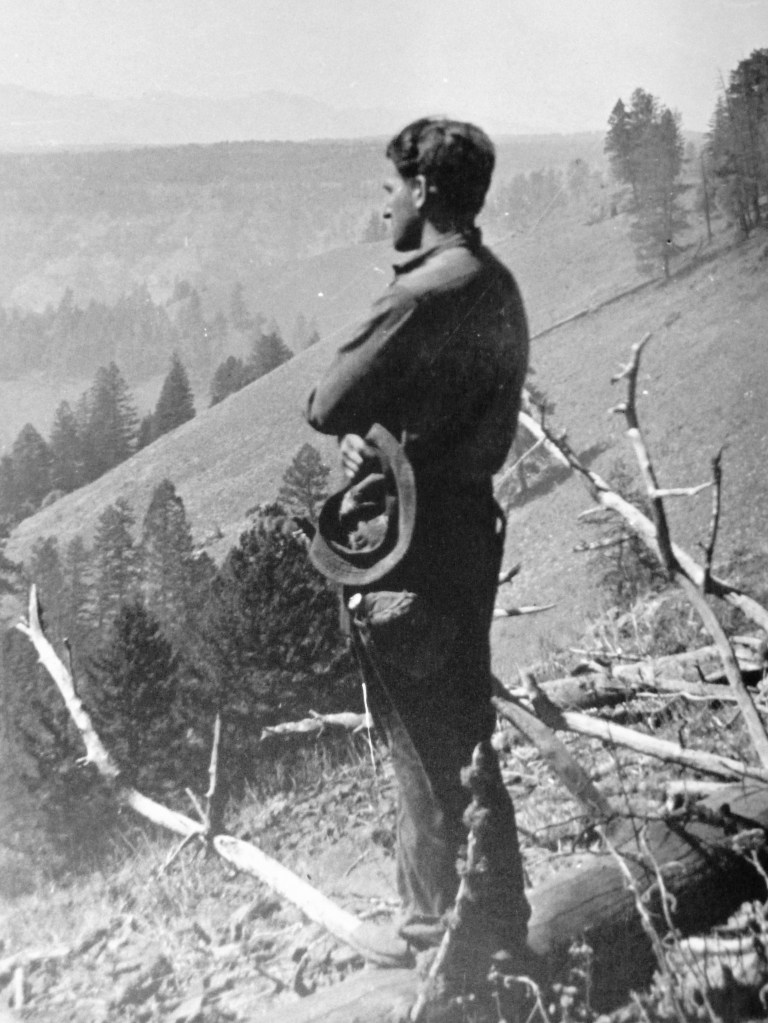
My dad as a young man, looking, always looking