
Some Qualities of Good Leadership

Does Donald Trump Exhibit Any?

BILL ASTORE

SEP 29, 2025

Recently, I jotted down some qualities of good leadership. Of course, the importance of specific traits depends on context—a leader who is overly cautious may be a liability in a crisis requiring quick action, though less so in a college faculty meeting. That said, here are thirteen attributes I consider essential, in no particular order:

· Decisiveness balanced with care: the ability to decide informed by experience and consultation.

· Integrity and character.

· Bringing people together–motivating and inspiring them.

· Calmness under pressure.

· Leading by example, or “walking the walk.”

· Honor and trustworthiness.

· A commitment to fairness. Setting high standards that apply equally to all.

· Selflessness. A belief in service.

· Compassion. A hard-ass shouldn’t have a hard heart.

· Open-mindedness. A willingness to listen.

· Humility. A willingness to admit no one knows everything or always gets it right.

· Experience (again). While people want to know a leader cares, they also expect competence. Confidence erodes quickly if a leader doesn’t grasp the fundamentals of the job and mission.

· A commitment to ethics, or “doing the right thing.

That’s my baker’s dozen. Sadly, when I measure Donald Trump against these qualities, I don’t see him embodying any of them with consistency. Yet his supporters insist he is not only effective but “great.” In Trump’s case, does he have the integrity to support and defend the U.S. Constitution? Does he realize that no man is above the law? Is the example he sets a selfless one? Does he bring people together for the greater good?

In business and the military, leadership is often judged narrowly by results—profits earned, battles won. But that standard can elevate sociopaths, people who care only about themselves and about producing results at any cost. Such leaders may achieve short-term gains, like higher profits, but at immense costs to those beneath them. Ultimately, a self-absorbed, “results-at-any-cost” leader drives organizations into the ground.

Leadership can be lonely, in the sense of “uneasy lies the head that wears a crown.” True leaders must sometimes accept unpopularity, stand firm, and take responsibility—“the buck stops here.” Leadership is both privilege and burden, which is why many shy away from it. Sociopaths, by contrast, don’t hesitate; they feel no weight from the consequences of their actions.

So, America, are we doing our best to identify the right—truly qualified—leaders? Evidence suggests we are not.

A final thought. I was once asked, as a young lieutenant competing for “Company Grade Office of the Quarter,” to explain the difference between management and leadership. For management, I said something about teamwork, smarts, effectiveness—taking on a project and bringing it to fruition. For leadership, I remember saying something like the ability to make good things happen. Here I was inspired by Chief Dan George in “Little Big Man” when he asks the Great Spirit “to grant me my old power—to make things happen.” And I remember a friend of mine, another lieutenant, saying the selection board loved short snappy answers. Maybe it was true—I won the award for that quarter.
Random Thoughts on Death, Dying, and the Reality of America’s Wars

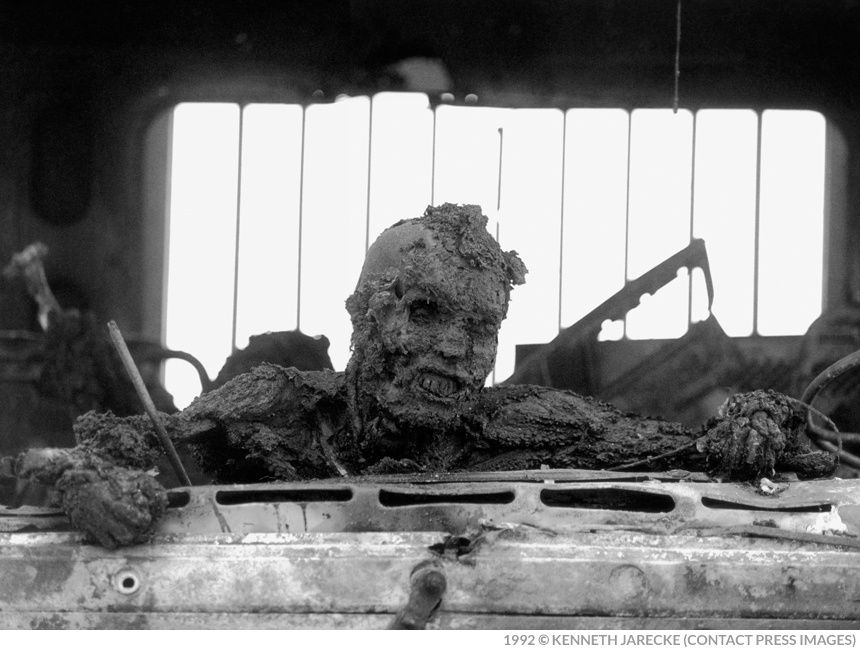
Jarecke's photo of a dead Iraqi was considered too disturbing to publish in America
Kenneth Jarecke’s 1991 photo of a dead Iraqi was considered too disturbing to publish in America

W.J. Astore

Americans tend to fear death.  It makes us uncomfortable.  Yet death is inevitable.  Its inevitability should teach us to revel in the richness of the here and now.  It should also teach us the foolishness of undue pride.

All is vanity, the Bible teaches.  Death reminds us of this — that human vanity, as unavoidable as it may be, is ultimately shallow.  There are riches out there that we should seek away from the glaring and garish light of vanity.  Riches that give deeper meaning to life.

Of all cultures in the world, I wonder if there’s another that ignores or denies death as much as American culture.  We’re the culture of new beginnings, fresh starts, reinvention, and also of the perpetual now, of youth, of defying or denying death through face lifts, cosmetics, adrenalin-driven adventures, and so on.  Technology and consumerism also provide distractions.  After all, how can I be nearing the end if I have the latest iPhone or iPad or if I’m wearing the latest hip fashions?

Our funeral homes seek to deny death with open casket rituals in which the dead person is made up to look alive.  Paul Fussell skewered this cultural tendency in his book, Class.  We use euphemisms like “passed away” or “passed on” for “died”; the descriptive term of “undertaker” has morphed into “funeral home director.”  Our religions stress life after death, not death itself.

We even deny that our wars produce death.  Think of the Bush/Cheney Administration, which refused to show photographs of flag-draped coffins of American troops, ostensibly for “privacy” reasons but mainly to minimize the deadly costs of fighting in Iraq and Afghanistan.  (Indeed, we don’t talk of troops dying in combat; we talk instead of troops “paying the ultimate price” or “making the ultimate sacrifice.”)

In minimizing the cost of war to its troops, the U.S. government and media also seek to deny the reality of death to the enemy.  War coverage in the media is often stock footage showing drones or aircraft firing missiles, enhanced by graphics and music.  You might see an enemy building or truck blowing up, but you’ll never see dead bodies.  Too disturbing, even though violent gun play and bleeding corpses are routinely shown in American crime shows and movies as entertainment.

In the first Iraq war (Desert Storm) in 1991, the photographer Kenneth Jarecke caught a powerful image of a dead Iraqi soldier burnt alive in his truck on the infamous “highway of death.”  Jarecke believed his photo would change America’s vision of the war, which in the U.S. media had been staged like a Hollywood production, neat and sanitary and clean.  But no U.S. media outlet would publish the image.  It was relegated to overseas publications.

What price do we pay as a people by ignoring death?  We lack a certain depth and maturity; put differently, we are callous and shallow.  Death has little meaning to us, especially the deaths of those in other lands.  For in seeking to deny the inevitability of our own deaths, how can we possibly recognize and process the death of others?

A death-denying culture that rains death on others using drones named “Predator” and “Reaper”; a culture that finds images of war dead too disturbing even as its TVs and movies and videos are saturated by bloody murders.  What are we to make of this?

The most powerful speech I’ve seen in any movie is that of Chief Dan George in “Little Big Man.”  In trying to make sense of the White Man’s war on Native Americans, Chief Dan George’s character, Old Lodge Skins, suggests that the White Man kills because he believes everything is dead already.  Lacking a moral center, the White Man has no sense of, or appreciation for, the sanctity of life.

Do we deny death because in some sense we are already dead?  Dead to the richness and sanctity of life?

Random thoughts, as promised.  But I hope they stimulate thought.  What say you, readers?

Apache Scouts, Listening; Hollywood, Not Listening

Apache Scouts, Listening (National Gallery of Art)

W.J. Astore

Frederic Remington understood the color of night, and he also understood something of the uniqueness of the Native Americans he painted.  This lesson was brought home to me by David Heidler, a good friend and a leading historian of American history.  Visiting an exhibition of Remington’s nocturnes, Heidler had this to say about how these paintings moved him:

[Remington’s works] reminded [me] of something easily forgotten by the sanitized depictions of Indians inflicted on our own times.  Remington was able to portray them as obviously aboriginal while preserving their stoicism and majesty.  Hollywood Indians, whether in Kevin Costner’s wolf-waltzing epic or the Mohican picture featuring the terminally taciturn Daniel Day Lewis as foil for the grumpily taciturn Russell Means, are simply European ethnics festooned in feathers and possessed of nifty woodcraft.

Remington’s Indians, though, are people so alien that one instantly recognizes them as part of another world uneasily coming to terms with an encroaching one.  His “Apache Scouts, Listening” perfectly captures the odd division between the near-feral instincts of the scouts and the tentativeness of their army employers.  The several Apaches are in various postures, mainly ones of repose, but their necks are elongated, their broad faces frozen with concentration and all directed just beyond the viewer; the two army officers sit on horses in the background, their hands cupping their ears in an effort to hear that the Apaches obviously can detect with ease.  It is night and winter, and a full moon illuminates the scene with jarring clarity, the light ambient from the heavy snow on the ground.

I could still be standing there watching it if allowed to.

Few Hollywood movies that I’ve seen capture the distinctiveness and uniqueness of Native Americans on their terms.  Our movies are mitigated (or polluted) by the Western gaze, tending to portray Indians as either “savages” or mystical proto-environmentalists/Zen gurus.  We see what we want to see, not what is.

Back in the bad old days of John Wayne westerns, Indians were typically portrayed as savages who deserved to be extirpated or shunted on to reservations where they could be “civilized.”  Nowadays, the “magical” Indian is more common, a noble brave and guru to the White man who highlights the White man’s materialism, prejudice, and violence.

Although it’s not a perfect movie (it has its own political agenda), “Little Big Man” with Dustin Hoffman and Chief Dan George captures at least some of the distinctiveness of Indians, at least for me.  The decision to allow the Indians to speak fluently in English (when it’s meant to be Cheyenne) helps to bridge the gap of understanding (no Pidgin English as in old westerns, and no distracting subtitles as in the sanctimonious “Dances with Wolves”).

The depiction of Native Americans in LBM is neither universally positive nor negative.  The brutality of Indians is shown in the opening scene of carnage in the aftermath of an attack on White settlers.  The Cheyenne encampment is described in humorous terms (from my memory): “When first entering an Indian camp, one might be excused from thinking, I’ve seen the dump.  Where’s the camp?”  It’s an amusing reminder that standards of cleanliness for Plains Indians differed from White town folk.  The Cheyenne also eat boiled dog, which the narrator (Hoffman) describes as downright delicate in taste (I doubt that scene would survive Humane Society inspection today).

But for me the most harrowing scene is Chief Dan George’s masterful speech as he holds a scalp.  He explains how the Indians (the “human beings”) believe everything is alive but the White man believes everything is dead.  It captures the animism of the Indians and their connection to nature while highlighting the instrumentalism and ruthlessness of (some) Whites.

The gulf in understanding between our peoples only exacerbated the wars over turf.  And the Indians sensed, as Chief Dan George says in the movie, that they were on the losing side of the demographics (an endless supply of White men, but a limited number of Human Beings, notes Chief Dan George).

But watch “Little Big Man” for yourself and draw your own conclusions.  Even better, take a close look at Remington’s nocturnes.  Try to place yourself in the paintings as my friend David Heidler so powerfully did.  Such a vivid exercise in imaginative exploration — using Remington’s work as a time machine that transports you to a different world among a people who are far more diverse and complicated and alien than Hollywood has ever managed to capture — is both transfixing and transformative.  And fun!

Author’s note: I’d like to thank David Heidler for his permission to cite and share his personal (and moving) reaction to Remington.