
War in Somalia

I need to get smart on this

BILL ASTORE

AUG 07, 2025

With an ongoing genocide in Gaza and a dangerous war between Russia and Ukraine, who has the time to look to Africa? As we said when I was still in the military, I need to get smart on this.

Coverage of America’s military adventurism/fiascos in Africa is difficult to come by. Fortunately, there’s Nick Turse at The Intercept, whose latest article is entitled:

PENTAGON: U.S. COUNTERTERRORISM EFFORTS HAVE FAILED AFRICANS

A new Pentagon report sheds light on AFRICOM’s disastrous counterterrorism campaigns.

I know Nick Turse from his days at TomDispatch, so I sent him this note in response to his article:

Bombing worked so well to win the war in Indochina — so why not bomb in Africa?

It seems like the goal is permanent war — you throw gasoline on it with all the weapons exports and drone strikes. And they work — war continues.

I guess that’s my obvious take — pay no attention to their words, watch instead what they do. It’s just war and more war. Given that AFRICOM is a military command, should we be surprised that the “solutions” are always violent ones?

That seems to be the U.S. “strategy” in Africa: bomb the “terrorists” while exporting more weapons related to military “assistance” (the building of indigenous African forces ostensibly allied to the U.S.). Again, it’s a strategy that worked so well in Indochina in the early 1960s …
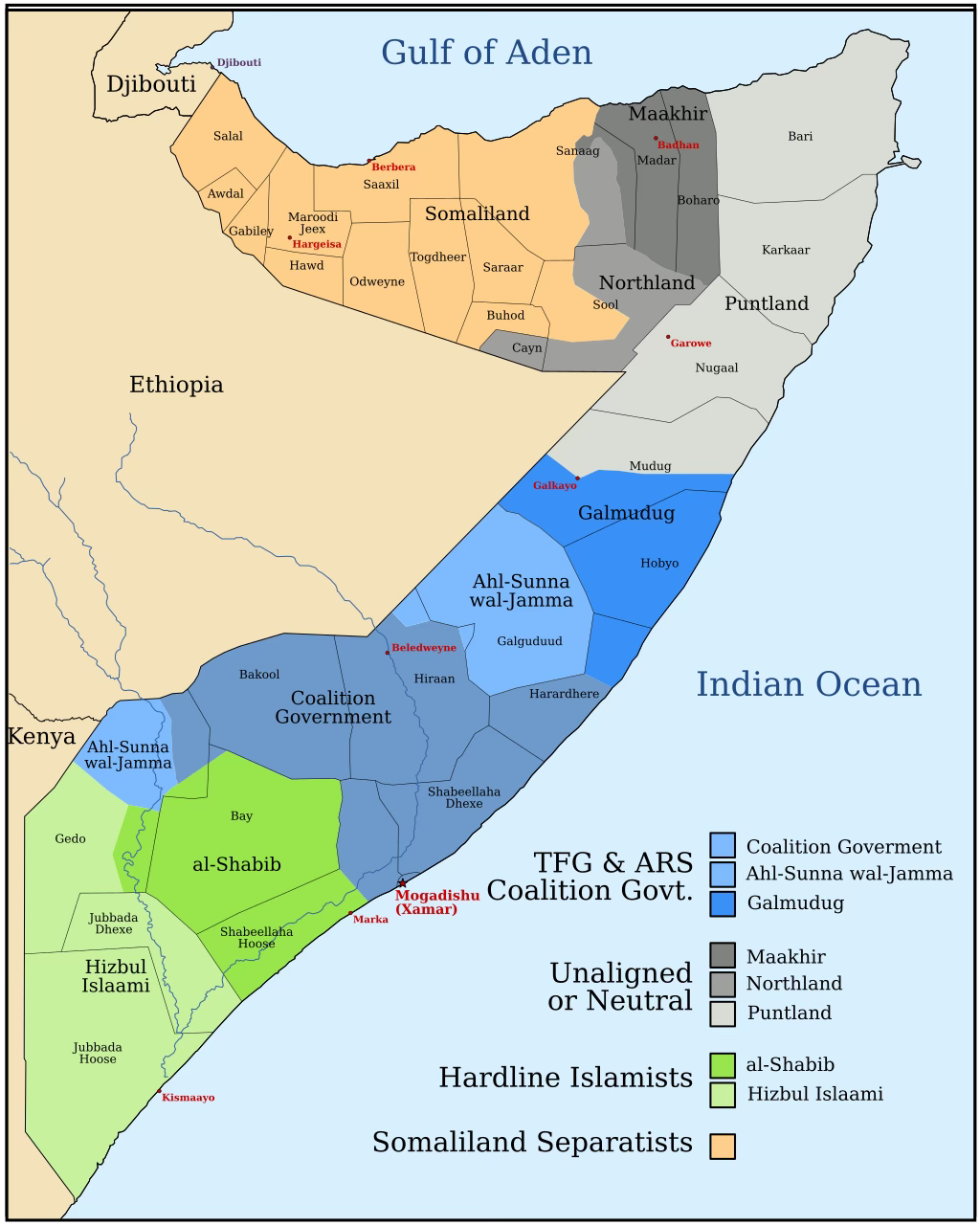
Unfortunately for Somalia, it occupies a strategic position in the Horn of Africa. The U.S. has a major military base in Djibouti.

Besides the perpetuation of war there, I don’t know what the U.S. government is up to in Africa. The mainstream media rarely discusses it. I assume control of scarce resources is a major goal. Also, the military-first AFRICOM approach to the area ensures higher profits for and more power to the military-industrial complex. Geographically, the Horn of Africa is vital to the control of sea and trade routes. Proximity to Yemen, Saudi Arabia, and the Red Sea is obvious. 

In short, I’m exposing my own ignorance as a way of encouraging all of us to get a bit smarter about what our government is up to in Africa. According to the Pentagon’s own sponsored report, it’s not going well. Here’s the kicker from Turse’s article:

“Africa has experienced roughly 155,000 militant Islamist group-linked deaths over the past decade,” reads a new report by the Africa Center for Strategic Studies, a Pentagon research institution. “Somalia and the Sahel have now experienced more militant Islamist-related fatalities over the past decade (each over 49,000) than any other region.”

“What many people don’t know is that the United States’ post-9/11 counterterrorism operations actually contributed to and intensified the present-day crisis and surge of violent deaths in the Sahel and Somalia,” Stephanie Savell, director of the Costs of War Project at Brown University, told The Intercept, referencing the frequent targeting of minority ethnic groups by U.S. partners during counterterrorism operations.

The U.S. provided tens of millions of dollars in weapons and training to the governments of countries like Burkina Faso and Niger, which are experiencing the worst spikes in violent deaths today, she said. “In those critical early years, those governments used the infusion of U.S. military funding, weapons, and training to target marginalized groups within their own borders, intensifying the cycle of violence we now see wreaking such a devastating human toll.”

Terrorist groups are also gaining ground at an exponential rate. “The past year has also seen militant Islamists [sic] groups in the Sahel and Somalia expand their hold on territory,” according to the Africa Center. “Across Africa, an estimated 950,000 square kilometers (367,000 square miles) of populated territories are outside government control due to militant Islamist insurgencies. This is equivalent to the size of Tanzania.” And as militant groups have expanded their reach, Africans have paid a grave price: a 60 percent increase in fatalities since 2023, compared with deaths from 2020 to 2022, according to the report.

As Turse notes, U.S. special forces deployed to Somalia soon after 9/11 as part of the global war on terror (or, if you prefer, the global war of terror). More than two decades of U.S. military strikes (and strife) in the area have only made matters worse. Can we as a nation stand for more of this “success”?

I think the U.S. strategy in Africa is to continue on the same course while suppressing the news of our failures there. Our influence in the region, such as it is, is military-driven, i.e. various African leaders want our weapons and money but little else (because we have little else to offer).

So, all our military leaders can boast of in the region is colossal air strikes. Did you know we used 60 tons of bombs to kill 14 militants in Somalia last February? Victory indeed will soon be ours … if you define “victory” as rising profits for the bomb-makers.

Readers, help me out. If any of you are following America’s war in Africa, I welcome your insights.
I Had A Base in Africa: Nick Turse on the U.S. Military and AFRICOM

turse

W.J. Astore

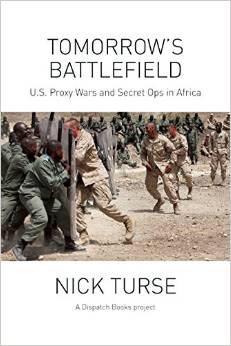
In the movie Out of Africa, Meryl Streep (playing Karen Blixen, who used the pen name of Isak Dinesen) wistfully intones, “I had a farm in Africa.” It’s a considerable understatement given her character’s ambition and energy and drive.  Rather than out of Africa, the U.S. military’s new motto is Into Africa, and like those cocky European colonialists of old, the military has plenty of ambition and energy and drive.  So notes Nick Turse in his latest book, “Tomorrow’s Battlefield: US Proxy Wars and Secret Ops in Africa.”  Turse, the prize-winning author of “Kill Anything that Moves,” a searing examination of America’s war against Vietnam, turns his sharp eye to yet another misguided U.S. military adventure, this time within and across the continent of Africa.  What he finds is disturbing.

The U.S. Army likes to talk about BLUF, or giving the bottom line up front, and Turse has a doozy on America’s militarized designs on Africa:

Over the course of the Obama presidency, American efforts on the [African] continent have become ever more militarized in terms of troops and bases, missions and money.  And yet from Libya to the Gulf of Guinea, Mali to this camp in South Sudan, the results have been dismal.  Countless military exercises, counterterrorism operations, humanitarian projects, and training missions, backed by billions of dollars of taxpayer money, have all evaporated in the face of coups, civil wars, human rights abuses, terror attacks, and poorly coordinated aid efforts.  The human toll is incalculable.  And there appears to be no end in sight.” (184)

A grim BLUF indeed.  Perhaps that explains why the U.S. military is so reluctant to give Turse any information, even seemingly innocuous data such as the number of bases the U.S. has in Africa.  Turse, who happily has a sense of humor, recounts tedious and frustrating battles with military public affairs officers as the latter employ various delaying tactics to stymie him.  Indeed, if the U.S. military was as effective at winning wars as it is at fighting reporters, we might truly have a military that’s second to none.  Turse perseveres through all this, relying on public sources, freedom of information requests, interviews, and other creative means to tease out the numerous ways AFRICOM is seeking to penetrate the continent.

(As an aside, it’s worth noting that reporters who pay fawning tribute to U.S. efforts in Africa are happily accommodated by military public affairs.  Turse, an old-school investigative reporter who’s not into fawning, gets stonewalled, his reward for having integrity.)

Though AFRICOM is eager to deny or minimize its “footprint” in Africa to Turse, the story is different when the military talks among themselves.  Turse begins by cleverly recounting a military change of command ceremony he attended in Germany in 2013.  At that ceremony, speaking freely to one another, U.S. military commanders were not reticent at all.  One military commander obsequiously praised his boss in these words: “General Linder has been saying, ‘Africa is the battlefield of tomorrow, today.’ And, sir, I couldn’t agree more.  This new battlefield is custom made for SOC [the Special Operations community], and we’ll thrive in it.  It’s exactly where we need to be today and I expect we’ll be for some time in the future.” (3)

Sir, I couldn’t agree more that Africa is already becoming a battlefield for U.S. special ops, now and in the future.  And it’s “custom made” for us — we’re going to thrive there!  Mark those words, America.  We’ve heard their like before in the jungles of Vietnam in the early 1960s, when America’s fledgling special ops community boasted then that Vietnam was tailor made for the counterinsurgency skills of U.S. elite warriors.  We were going to thrive there too.  And look where that got us!

Turse’s knowledge of Vietnam makes him sensitive to the perils of mission creep in Africa, the problems of winning hearts and minds in cultures poorly understand by American troops, the dilemma of overthrowing less-than-tractable leaders (long ago, Diem in South Vietnam; more recently, Gaddafi in Libya) and the chaos that often results when the “bad man” is gone, the proliferation of U.S. weaponry that often accelerates regional violence, and so on.  Rather than give an honest accounting of these difficulties, the U.S. military often prefers simply to declare victory, or at least to take credit for success, however partial or fleeting.  Indeed, as Turse tartly observes, when it comes to Africa and America’s military missions there, “it’s so much easier to claim success than to achieve it.” (168)

For anyone interested in the U.S. military and especially AFRICOM, Turse’s honest, no-BS account makes for cautionary reading.  It should be required reading for all U.S. military personnel assigned to Africa, who deserve to read honest criticism while being exposed to critical thinking.  It’s a helluva lot better than hearing “I couldn’t agree more, sir.”  And perhaps it’ll save the U.S. military from having to intone, tragically this time, “I had a base in Africa.”