

W.J. Astore
To them, the right lessons; to everyone else, the wrong ones
We just marked the 50th anniversary of the Fall of Saigon on April 30, 1975. Did American officials learn anything from the disastrous Vietnam War?
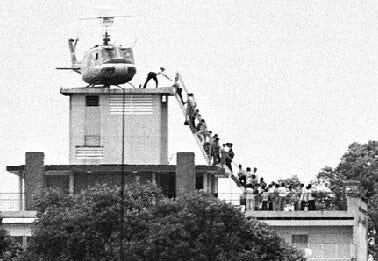
Of course they did. Just not the lessons you’d have wished they’d learned.
So, what did they learn?
- They learned that wars can indeed last forever, but that Vietnam wasn’t the best “forever war” for the military-industrial complex because it became deeply unpopular and was disrupting cohesion within the military itself. The best forever wars are open-ended “wars” like the global war on terror. And perhaps a “new Cold War” with Russia and/or China. Wars that don’t involve the deployment of over half a million men (unless that “new” Cold War turns hot).
- They learned to control the narrative. No more journalists traveling freely in war zones as in the 1960s in Vietnam. Journalists are now most often embedded in U.S. military units. Embedded reporters, dependent on the military for access and protection, know what they can and can’t say, even as they tend to sympathize with the troops they’re with.
- They learned that forced conscription via a draft doesn’t work well for unpopular wars. So they transformed the military into an “all-volunteer” force. Draftees may well be resentful, rightly so, but volunteers? Too bad—they volunteered for this.
- Along with “volunteers,” they learned to indoctrinate U.S. troops to be “warriors” and “warfighters” rather than citizen-soldiers. Warriors exist to fight wars, so shut up and blast away.
- They learned to keep the American people isolated from war and its deadly effects. Recall that under Bush/Cheney, Americans weren’t even allowed to see flag-draped caskets. During Vietnam, war was in America’s living rooms during dinner, complete with body counts. Coverage of wars in Iraq, Afghanistan, and elsewhere was sanitized, almost bloodlessly so.
- They learned never to talk of sacrifice (except by those volunteer warriors) by the American people. Taxes aren’t raised in the name of war. There are no war bond drives. America’s leaders tell the rest of us to enjoy life, to visit Disney and to go shopping, while “our” warriors fight overseas.
Together with those “lessons,” they continue to preach “peace through strength,” attacking those who truly seek peace as misguided (at best) and treasonous (at worst). As ever, they tend to attack those who’d dare criticize the U.S. military as ungrateful backstabbers. And of course they consistently obscure the truth of how poorly wars like Iraq and Afghanistan were going while holding no one in the upper echelons responsible and accountable for rampant corruption and disastrous endings.
All these “lessons” ensured that Vietnam wouldn’t be the last example of hubris, folly, and atrocity, and indeed it hasn’t been. Until the right lessons are learned, expect future repeats, tragic variations on a theme of Vietnam.


As a US helicopter pilot 1974–75 in Southeast Asia, I point out the proof that US leaders lied to the public, by claiming (1) that we fought a country called North Viet Nam, and (2) that we entered in 1954, presented as noble to fight communism. The 1954 Geneva Accords, Articles 1 & 14(a), download at Avalon Project, Indochina show the Accords kept VN as 1 country. France had a duty to administer the south half until elections.
No one else had any right to administer anything there. No North Viet Nam ever existed. Much later than Geneva, the US created a South Viet Nam. But the main operating provision of Geneva was the French duty to administer the south half. No one else had any right to administer. What happened?
Reports in U.S. National Archives from consuls in Viet Nam during 1889–1954 are about US business there, enabled by French invasion force. At least 252 microfilm reels contain at least 8,000 reports and papers. The records start with United States Consulate (1957). Despatches from United States consuls in Saigon, 1889–1906. Washington: National Archives and Records Service, General Services Administration, Reel 1.
These prove that hidden period of business enabled by force was the real reason behind the 1960s war. When France fell in defeat in 1954, US leaders attacked to try and continue that business by force.
LikeLike
For a full discussion of the above, including this writer’s two books, please see briandroesch.com.
This writer has spent 50 years digging for the real reason for the US-Viet Nam War, since returning in 1975. He became a trial lawyer and learned that digging to prove real facts determines what really happened. The hidden records of the US consuls prove what really happened. More proof supports that.
LikeLiked by 1 person
Surely fear of the spread of communism was involved but that doesn’t contradict your comment. At root, communism is a mortal threat…to profit. For the sake of business it had to be destroyed everywhere as a threat to foreign countries being profit centers for US business.
The irony is that US business has since then left the US for profit. It wants us to buy but it doesn’t want to pay the wages for US jobs. It is a rejection of what was called Fordism, Henry Ford’s idea that he had to pay his workers enough for them to afford his cars.
Right now, the ultimate drive for profit is clear in what Trump is doing to get rid of as much government work as possible so that it can be privatized. We all know what happens when privatization takes place, the money made goes to the management, proven by the unending increase in the wealth of the most wealthy.
This is why not just communism, but socialism must be destroyed wherever found. Services provided in the public interest and not for profit cannot be allowed, which is exactly why such things as the National Weather Service (NOAA) need to be dismantled and why action on limiting fossil fuel use, a huge threat to profit, must be eliminated.
Trumpism is simple – do what is best for profit. The end.
LikeLiked by 1 person
Your comment is correct on “the ultimate drive for profit”, but while that is the ultimate pursuit by US leaders, here are 5 things that show that is different than opposing communism. While opposing communism has been part of the drive for profit, the 5 examples (among many more) show it was only a factor.
1, US businesses operated in Viet Nam 1865–1954 enabled by French force, before opposing communism became a factor. By the late 1860s, US ships loaded rice for overseas sale. A 1945 French colonial report says that by the 1880s, widespread malnutrition existed and lasted the entire colonial period. (Citations available) That shows the US economy included the pursuit of business expansion and resource use, often by force, often against nonwhite people.
2, In the 1960s and into today, US leaders have not told but public about that early period, though the public demanded to know why the US was in Viet Nam. If that early business enabled by violence had somehow been to nobly oppose communism, US leaders would have told the public.
3, From 1619 onward, the US economy included the pursuit of business expansion and resource use, often by force, often against nonwhite people. In 1619, this started with using force against black people stolen from Africa by violence and enslaved in the pre-US and US economy. The violence continued sanctioned by law into the 1950s, as US history shows.
4, In the 1890s, Secretary of State John Foster, grandfather of John Foster Dulles & Allen Dulles, received regular reports from US consuls in Viet Nam. He and another diplomat relative of the young Dulles’s taught them about overseas business through colonialism. By about 1914, John Foster Dulles was an international lawyer dealing with Central American dictatorships. In 1919, John Foster Dulles & Allen Dulles were in the US delegation at Versailles that turned down Ho Chi Minh’s moderate petition for gradual freedoms. In 1921, John Foster Dulles was a founding member of the Council on Foreign Relations, with the consensus of “Access to raw materials and markets of the whole world should be secured for the United States.” Wala, M. (1994). The Council on Foreign Relations and American foreign policy in the early Cold War, pp. 9, 21. Allen Dulles joined the CFR in late 1920s. Into the 1950s, the powerful Dulles brothers were railing about opposing communism, but they never gave up their imperial profit motive. So the pursuit of profits, not freedom against communism, was their real goal. They used anti-communism, but never told the public about their own profit-enabled-by-force activities in Viet Nam and elsewhere.
5, On Africa in 2024, US leaders were exposed for providing military “security” in Niger while France took Niger uranium but paid 1/250th market value. Many Niger citizens lived in poverty.
Based on these and many more facts, it appears that your conclusion is valid about “the ultimate drive for profit.” And, it appears that opposing communism, while a factor, was not the real driving force of US leaders.
LikeLiked by 1 person
And it could be added that the most basic requirement of business is safety/security of property (offices, production facilities) and American employees in a foreign location and what is a guarantor of that? US military force ready to hand. What have we now…800 bases around the world and what has always been the desire of business…to expand to all markets everywhere. No head scratching is needed to see the connection. It is a logical extension of the case seen time and again in US history in-country. The company dominates a town and the police are right there to knock heads should any labor trouble pop up.
What they don’t teach in the history books! Smedley Butler’s comment about being a gangster for capitalism was as honest as a statement can be.
LikeLiked by 1 person
Your comment is right on, about the basic requirement of military giving safety/security for US businesses. That system confirms the Smedley Butler comment on being a gangster for capitalism. And, more facts show that this system rests on US civilian leaders from the Viet Nam era onward keeping the US public “ditched” from real facts on foreign policy. In the 1940s, as leaders set up this system, they said the project would be “ditched” if the public learned that State Dept & an outside group (of corporation people) were working together on it.
For, it is probable that some Americans, however small a percentage, who do not know that system of military safety/security for US businesses oversears would not like it if if they knew. As voters, they could swing the close national vote so that progressives win.
That is why US leaders during 1954–2025 have told the public two ludicrous false claims on Viet Nam: (1) That a country called “North Viet Nam” existed, and (2) That the US entered Viet Nam in 1954. As noted in a comment above, the 1954 Geneva Accords, Articles 1 & 14(a), download at Avalon Project, Indochina show the Accords kept VN as 1 country. France had a duty to administer the south half until elections. No “North Viet Nam” ever existed on this Earth. In plain words of 14(a), France’s duty in the south shows that Geneva did not create two countries. Instead, Viet Nam as one country with an estimated 90% support had just defeated France in 1954, and that 90% support did not evaporate. Instead, superpower US leaders pressured France to abandon its duty to administer.
Citation: France duty to administer; relations with US, money. Lawyers Committee on American Policy Towards Vietnam. Consultative Council. (1967). The Vietnam War and international law: The illegality of the United States military involvement (2d ed.). Flanders, N.J.: O’Hare Books, pp. 132, 139, 336.
And, the claim of a 1954 entry into VN is ludicrously false, given the hidden 1865–1954 US business there, enabled by brutal French invasion force. So, US leaders have kept it well-hidden. Albeit that U.S. Nat’l Archives contain about 252 microfilm reels of declassified reports and papers from US consuls in Viet Nam starting in 1889,
Moreover, upon exposure of the two false claims, the US public will not be happy at learning that US leaders took 58,220 members of the US public and and sent them to die in Viet Nam, unwittingly not knowing it was for the very system you describe, of military providing safety/security for US businesses in foreign lands.
LikeLiked by 1 person
Once again, well done, very well done. May I add three more lessons learned?
Since Viet Nam, they learned to make the public genuflect with the “Thank you for your service” mantra at every opportunity.
The learned to market the military with flyovers and flag-waving pageantry at virtually every professional sporting event.
They’ve further normalized forever war and “forward deployment” by cynically manipulating public sentiment with staged media events of a parent – but most often the father – still dressed in desert camouflage combat fatigues, appear unannounced after months of being away at his or her child’s elementary school.
Lessons to be learned in all of this for us, but we won’t, the narrative is too pervasive, too unchallengeable.
LikeLiked by 3 people
Correction: Should read “They learned to market the military…” evidently the comments section here don’t allow for edits to correct typos.
LikeLiked by 1 person