

W.J. Astore
Private health insurers make money denying care–not providing it
Luigi Mangione, the young man who shot and killed a senior health insurance executive, is emerging as a folk hero of sorts in America. This requires some explanation for people outside of America.

Most peer countries to the United States have national health care systems. Countries like Britain, Germany, France, Japan, New Zealand, and the like. These national health care systems, run by the government, are not perfect, but overall they are cheaper and produce better results for patients than the American system, where health care is basically wealth care for the rich and privileged.
America primarily has a privatized health care system where profit is the prime directive. (Programs like Medicare* and Medicaid are a public-private partnership and are government-funded; the former focuses on people 65 and older, the latter on the poorest of Americans.) Most Americans get their private health insurance with their job, else they’re required to buy private health insurance on their own nickel. These health insurance plans are expensive and often come with high deductibles and co-pays.
So, for example, when you visit a doctor for a routine appointment, your co-pay is likely between $50 and $100 per visit. If you get seriously sick, break a bone, etc., your health insurance provider may not start paying your bills until a certain yearly deductible is met, which may sit between $5000 and $10,000. Not surprisingly with these deductibles, co-pays, and the like, Americans often declare bankruptcy due to medical bills even when they have health insurance and are in theory “covered.”
A quick Google search reveals that an unsubsidized private health care plan for a family of four in America cost an average of $24,000 a year in 2023. Other figures suggest a cost of roughly $18,000 a year, but it depends on what state you live in as well as your age. The various plans that you can buy are quite complicated and include the aforementioned deductibles, co-pays, and other complexities. Employer-based plans cost less; perhaps in the neighborhood of $6000 to $8000 per year.
Again, health insurers’ #1 priority isn’t to provide health care. It’s to make money for shareholders—and for the senior executives in the industry. So their profit-driven approach to claims is the now infamous “deny, delay, depose (or defend)” strategy. As often as possible, they seek to deny claims outright, forcing sick and desperate people to fight an incomprehensible bureaucracy shrouded in fine-print legalese. Or they seek to delay payment on claims. Or they take Americans to court (“defend and depose”), forcing people to hire lawyers (quite expensive) while aiming for the quickest and cheapest settlement.
For the insurers, this strategy makes all the sense in the world. They are in this business to maximize profits and earnings, not to provide generous health care benefits.
Efforts to create a fairer and more just system for Americans have failed due to political corruption at the highest levels as well as propaganda (remember those rumored “death panels” if the government ran health care). The idea of a national non-profit healthcare system is nothing new; the Truman administration advocated for it after World War II, and various other proposals were floated by LBJ in the 1960s, the Clintons in the 1990s, and even tepidly by the ultimate sellout Barack Obama with his Affordable Care Act, which is unaffordable for many and less than generous with its care. These and similar efforts have failed as Big Pharma, the AMA, health insurers, and other forces have combined to exert tremendous pressure so as to prevent meaningful reforms that would cut into their profits, salaries, and market share.
Basically, the U.S. health wealth care system costs roughly double that of comparable countries with worse outcomes for patients. Again, this isn’t a surprising result, since the health and well-being of patients isn’t the guiding priority. It never has been. The U.S. system is all about producing the highest possible salaries and profits for Big Pharma, for health insurers, for privileged doctors (specialists often make yearly salaries in the high six-figures), and for all the other stakeholders (and shareholders) in the current system.
Here in America, the Hippocratic oath of “first do no harm” in medicine doesn’t apply. Our oath is the Gordon Gekko one of “Greed is good.” It doesn’t matter if people go bankrupt or die as a result. It’s wealth care, not health care, silly!
It’s unlikely the Trump administration will do anything to change this. Its top priority seems to be the expulsion of immigrants. Members of Congress are completely in the pocket of Big Pharma, the health insurers, and powerful medical lobbies, so don’t look for meaningful change there.
That’s why so many Americans, deeply frustrated with an exploitative system of healthwealth care, where costs rise year by year as benefits shrink, sympathize with Luigi Mangione, even if they disagree with his murderous method of expressing his anger and disgust.
Put bleakly, America’s health wealth care system is another way of enriching the few while impoverishing the rest. It is also a form of social control. (Act out, protest—lose your job, your health care, maybe your life.) Only the most revolutionary acts are likely to change this system. That is exactly why the government, the mainstream media, and corporate elites are acting to suppress sympathy for Mangione.
Consider this article by Ken Klippenstein about a mom who, frustrated with her health insurer, repeated “deny-delay-depose” while saying “you people are next” on the phone; she quickly apologized, but not before the police and FBI were called in and charged her with threatening “an act of terrorism.”
Know your place, Americans. Stay supine and obedient or they’ll take away your health insurance. Better yet, they’ll finally give you affordable health care—in prison.
*More on Medicare, courtesy of the Center for Medicare Advocacy
Most people think Medicare is a government program. That’s only partly true. While Congress created Medicare, and continues to develop Medicare coverage and appeal rules, decisions to pay claims are actually made by private companies. The government does not make those decisions. This was one of the compromises made in order to pass Medicare in 1965 – and the public-private partnership continues to date.
Indeed, the entities granting or denying coverage, and those deciding whether or not to pay claims, are mostly private insurance companies. For example, Anthem is the parent company of “National Government Services,” one of the major Medicare claims administrators. Another Medicare administrative contractor, “MAXIMUS,” is a for-profit company that helps state, federal and foreign governments administer programs.
In addition, about 30% of Medicare beneficiaries are enrolled in private “Medicare Advantage” plans. These plans are also run by private companies, mostly within the insurance industry, and they make Medicare initial coverage decisions for their enrollees.
We know that when Medicare is working right and covering necessary care, everyone is content. But, if coverage is denied unfairly… don’t blame the government. It’s probably not “Medicare” that made the decision; it’s most likely a private insurance company that’s paid by Medicare to make coverage decisions.
Thanks to a reader, Sally Moore, for pointing out the public-private nature of Medicare. It’s more complicated than I thought—I should have known better.
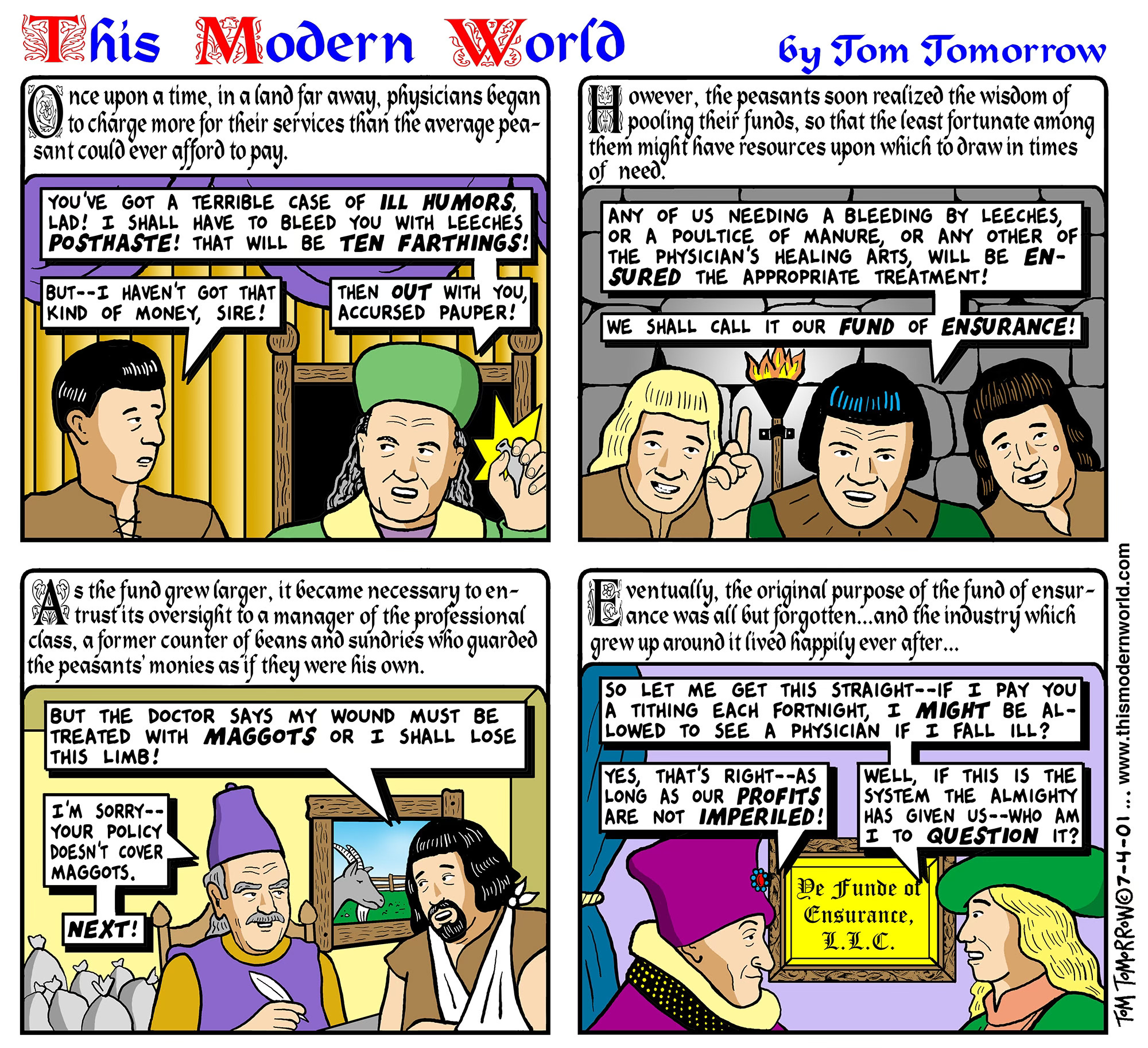
Update: A classic cartoon from Tom Tomorrow seems appropriate here:
 Bracing Views
That cartoon is very funny.
One thing that hasn’t been made-fun-of however is the carve-out provision for human beings who have entered the United States illegally, who get health services completely free of charge.
LikeLike
The American healthcare insurance industry wants to become more profitable, even if many lives are lost as a result. It really does seem there’s little or no accountability when huge profit is involved; nor can there be a sufficiently guilty conscience if the malpractice is continued, business as usual. ‘We are a capitalist nation, after all,’ the morally lame self-justification typically goes.
I dread the day our (Canada’s) “universal” health-care system includes crucial health treatments that, at least in a timely thus beneficial manner, are universally inaccessible, except for those with the money to access privately at for-big-profit prices. Abroad, we are often envied for our supposedly universal healthcare, yet, in a significant way, it comes second to the big-profit interests of industry.
A late-2019 Angus Reid study found that over the previous year almost a quarter of Canadians decided against filling a prescription or having one renewed due to medication unaffordability. Resultantly, many low-income outpatients who cannot afford to fill their prescriptions end up back in the hospital system as a result, therefore costing far more for provincial and federal government health ministries than if the medication had been covered.
The study also found that around 90 percent of Canadians — and three quarters of Conservative Party supporters specifically, who definitely are not known for championing publicly-funded social programs — favor a national ‘pharmacare’ plan. Another 77 percent believed this should be a high-priority matter for the federal government.
It’s notably expensive and morally wrong when an elected government will promise the people much-needed universal albeit-generic-brand medication coverage only to have the pharmaceutical industry typically react with successful threats to abandon their Canada-based R&D, etcetera, if the government goes ahead with the ‘pharmacare’ plan. While such universal medication coverage would negatively affect the industry’s superfluously plentiful profits, the profits would nonetheless remain great, just not as great.
Clearly, a truly universal healthcare system needs to be supported by a pharmacare plan. Instead, we continue to be the world’s sole nation that has universal healthcare (theoretically, anyway) but no similar blanket coverage of prescribed medication, however necessary. Ergo, in order for the industry to continue raking in huge profits, Canadians and their health, as both individual consumers and a taxpaying collective, must lose out big time.
LikeLike
There must be a point at which corporate greed thus practice — where already large corporate profits are maintained or increased while many people can’t afford even basic necessities (including healthcare) — will end up hurting big business’s own monetary interests. I can imagine that a healthy, strong and large consumer base — and not just very wealthy consumers — are needed.
Or is the unlimited-profit objective/nature somehow irresistible? It brings to mind the allegorical fox stung by the instinct-abiding scorpion while ferrying it across the river, leaving both to drown.
The more that such corporations make, all the more they want — nay, need — to make next quarterly. It’s never enough. Maximizing profits at the expense of those with so much less, or nothing, will likely always be a significant part of the nature of the big business beast.
One can see corporate officers shrugging their shoulders and defensively saying their job is to protect shareholders’ bottom-line interests. And the shareholders also shrug their shoulders while defensively stating they just collect the dividends and that the big bosses are the ones to make the moral and ethical decisions.
Meanwhile, the common yet questionable refrain incredibly still prevails amongst supposedly-free-market capitalist nation governments and corporate circles: It claims that best business practices, including what’s best for consumers, are best decided by business decision-makers. But that has been proven deadly false numerous times.
Also, increasingly problematic is the very large and growing populace who are too overworked, worried and even angry about food and housing unaffordability for themselves or their family — all while on insufficient income — to criticize or boycott Big Industry for the societal damage it needlessly causes/allows, particularly when not immediately observable.
It really does seem there’s no human(e) or moral accountability when big profit is involved; nor can there be a sufficiently guilty conscience if the malpractice is continued, business as usual. ‘We are a capitalist nation, after all,’ the morally lame self-justification goes.
Worsening matters, such big businesses can get, or are getting, unaccountably even bigger, defying the very spirit of government rules established to ensure healthy competition by limiting concentrated ownership.
LikeLike
“The point is, ladies and gentlemen, that greed, for lack of a better word, is good. Greed is right. Greed works. Greed clarifies, cuts through and captures the essence of the evolutionary spirit. Greed, in all of its forms — greed for life, for money, for love, knowledge — has marked the upward surge of mankind …”
.
“It’s not a question of enough, pal. It’s a zero-sum game — somebody wins, somebody loses. Money itself isn’t lost or made; it’s simply transferred — from one perception to another. Like magic.”
.
—the morbidly greedy and corrupt bank-financier Gordon Gekko (Wall Street, 1987)
LikeLike