

W.J. Astore
The Stupidity of the Sentinel ICBM and the B-21 Raider Bomber
My fellow Americans, your government wants to spend nearly $2 trillion over the next 30 years to “modernize” its nuclear arsenal. Modernization, of course, is a euphemism. And the Pentagon actually uses the word “invest” rather than “spend.” The dividends on this “investment” go to the weapons makers, obviously, not to the American people.
Let’s first consider the Sentinel ICBM; the military wants to buy 400+ of these and stuff them in fixed silos in places like Wyoming and North Dakota. Land-based ICBMs were (among other things) obsolete by the 1970s; that’s why the MX was developed as a mobile system under President Jimmy Carter. Fortunately, the shell-game idea of moving nuclear missiles around by truck or rail was too dear and dumb even for the government. You don’t “modernize” that which is obsolete and redundant (and escalatory due to its inherent vulnerability). The smart move here is to eliminate land-based ICBMs.
Speaking as a retired Air Force officer, my old service will always want more of everything, including that which is obsolete. It’s all about budgetary share. No enemy is more to be dominated than the other services, who are also competing for money.
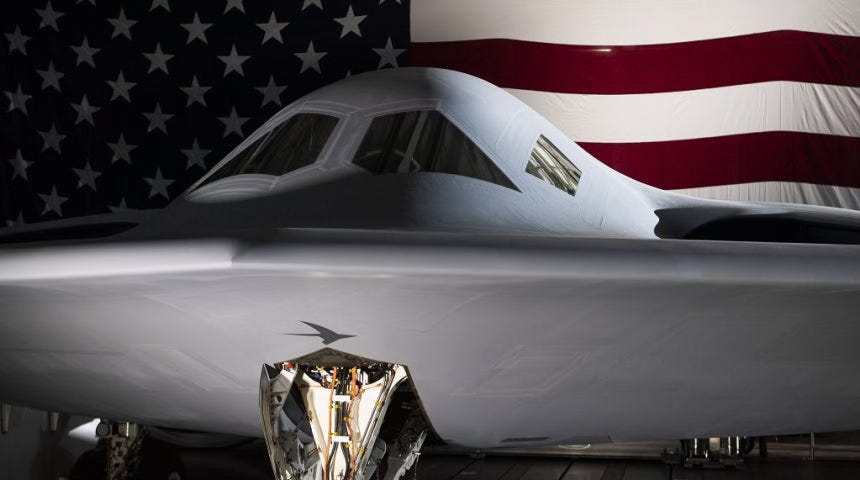
Similarly, strategic bombers to drop nuclear bombs (or even to launch cruise missiles) are not needed for nuclear deterrence. The whole idea of “penetrating” strategic bombers was obsolete by the late 1970s, which is why President Carter cancelled the B-1 bomber (it was revived by Ronald Reagan). We simply don’t need more strategic nuclear bombers–but the AF will always want them. If pilots can fly it (even if they have to do it remotely, as with drones), the AF wants it. Who cares if the B-21 will cost roughly $1 billion per plane when it’s finally fielded?
There is no need for the Sentinel or Raider. But the Air Force will fight until doomsday to protect its budgetary authority and the pilot and command billets that come with nuke missile fields and planes.
Let’s never forget the power of the industrial side of the military-industrial complex as well. There are hundreds—even thousands— of billions of dollars at stake here, so of course industry will fight to the end (of all of us) for the money. Weapons makers will spend millions on lobbyists, and millions more to buy politicians, to make billions in return. The profit margin here is better than crypto or most anything, actually.
They say alchemists were wrong that lead could be turned into gold, but every day the lead of bullets is sold, earning gold for the weapons makers, so alchemy is real after all. Now America’s weapons makers are turning radioactive uranium and plutonium into nearly $2 trillion in gold (or paper money, at least), the ultimate alchemical trick.
Don’t let them do it, America.


People need to read what the bulletin of the atom scientist says. The nuclear pits are good for another 30 years. That is what the STOCK PILE STEWART PROGRAM has been about since 1993.
LikeLike
While actor-turned-president Ronald Reagan postulated that “Of the four wars in my lifetime none came about because the U.S. was too strong,” who can know what may have historically come to fruition had the U.S. remained the sole possessor of atomic weaponry. After all, absolute power is known to corrupt absolutely.
After President Harry S. Truman relieved General Douglas MacArthur as commander of the forces warring with North Korea — for the latter’s remarks about using many atomic bombs to promptly end the war — Americans’ approval-rating of the president dropped to 23 percent. It was a record-breaking low, even lower than the worst approval-rating points of the presidencies of Richard Nixon and Lyndon Johnson.
Had it not been for the formidable international pressure on Truman (and perhaps his personal morality) to relieve MacArthur as commander, Truman may have eventually succumbed to domestic political pressure to allow MacArthur’s command to continue.
Today, it seems the U.S. still expects the international community to accept that an American presidency would never initiate a nuclear-weapons exchange. But how can that be known for sure, especially with U.S. foreign-policy history?
LikeLike