

W.J. Astore
Overconfidence and Profiteering Trumped Humility and Public Service
Here are a few thoughts on America’s response to Covid that I hope are useful, especially in light of RFK Jr’s nomination to run health and human services. RFK is often portrayed as an “anti-vaxxer,” when, as I understand it, he is more of a skeptic or a critic of certain vaccines, whether of their efficacy or possible side effects. He’s associated with assertions that vaccines could be linked to higher rates of autism in children, with questions about the use of mercury (now eliminated) in trace quantities in certain vaccines.
People seem concerned that RFK is eroding parents’ trust in vaccines, especially for preventable childhood diseases like measles, mumps, and the like. It’s also true that vaccines are money-makers for big pharmaceutical companies, so some skepticism or at least caution may be warranted when claims are made that vaccines are 100% safe and effective. (That certainly wasn’t true of the various Covid vaccines.) When tackling such issues, I’d defer to the experts you trust, such as your pediatrician or your family practitioner. Don’t listen to RFK—and certainly don’t listen to me. My doctorate is in history, not medicine.
Medical science can survive the skepticism of RFK and maybe even profit from it in the sense of being more truthful and transparent about vaccine efficacy and risks.
Anyhow, here are some thoughts about the Covid crisis that I jotted down about two years ago.
*****
The Covid response by the U.S. government and medical community was a highly complex event. The whole idea of flattening the curve (so as to not overwhelm hospitals with patients) made sense to me. The vaccines, rushed into production, weren’t even close to perfect (“leaky” was the word used), and there were some people injured by them, but overall Operation Warp Speed made sense to me. As a precaution, my wife and I got the initial two shots and wore masks when we had to. We never got subsequent shots or boosters. (We were not in vulnerable risk categories and our doctor told us the virus was changing too rapidly for the boosters to offer much protection.)
That said, mortality in the U.S. due to Covid was very high compared to other countries that had less access to the vaccines. It’s unclear why, though preexisting conditions like obesity or compromised immune systems contributed.
What is clear is the upward transfer of wealth driven by the pandemic response as passed by Congress and the unequal suffering of small businesses compared to giants like Amazon. The Covid response created more billionaires in the U.S. and even wider discrepancies between the “haves” and “have-nots.” Meanwhile, lots of older Americans died in nursing and veterans’ homes, and America ultimately lost more than a million people to Covid and its complications.
What pissed many people off was the way in which the so-called experts insisted that they knew what they were doing even when they clearly didn’t. There was a lot of uncertainty about the origins of Covid and how best to contain it, but the government showed no humility. The message was “obey” us because we know best.
Again, I’m not defending anti-vaxxers. I’m pointing out that Covid vaccines were “leaky” because they didn’t prevent transmission, nor did they prevent Covid. Many so-called experts oversold the vaccines, saying they would prevent infection and transmission. Those statements proved to be wrong.
Medical science is a realm of complexity and uncertainty, and when it meets the realm of politics, especially as structured in the U.S., where you’re either “blue” or “red,” and where politicians avoid complexity as dangerous to one’s reputation, both realms suffer from the mix, especially medicine and science.
What we really needed during the Covid pandemic was humility before uncertainty. What we got was arrogance and an illusion of certainty. Trump, obviously, was way out of his depth. His ignorance put a premium on the experts to act like, well, experts. To admit uncertainty. To turn aside from overconfident statements issued literally in the name of science.
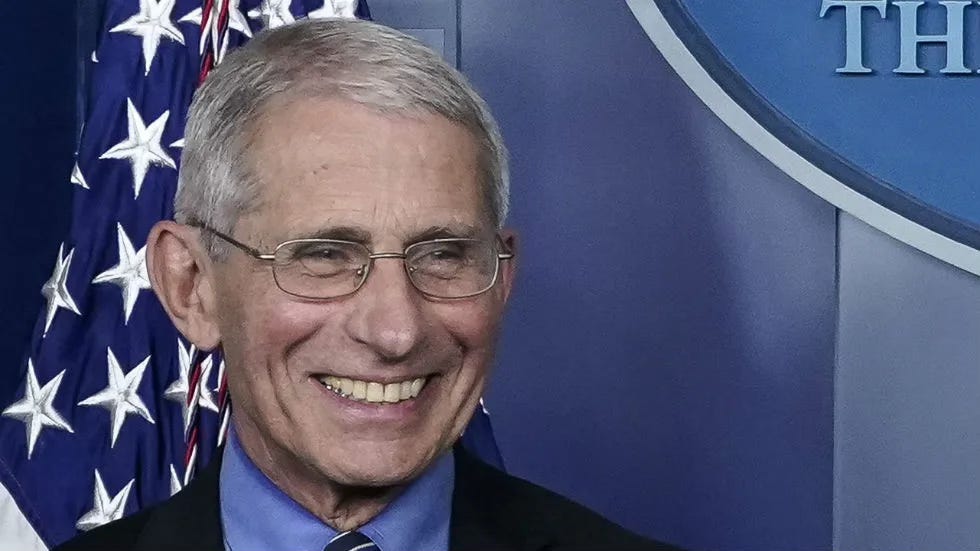
Anthony Fauci, if nothing else, forgot to be humble. Forgot how to be an expert. Instead, he became a poseur. Just about everyone knew Trump was clueless. We expected more from a medical doctor, more transparency, a greater command over the facts, so the sense of betrayal was that much greater.
As a historian of science, I’m certainly not anti-science. Medical science at “warp speed” is tricky, however. There was a rushed effort to develop vaccines quickly, and not all of them were equally safe and effective. Calculated risks were taken in the cause of saving lives—and some people were vaccine-injured as a result. This doesn’t mean, of course, that vaccines are somehow “bad.” Most vaccines are safe and effective. Again, trust your doctor. And educate yourself. But remember too that a little knowledge can sometimes be a dangerous thing.
*****END OF NOTES
I just hope the experts learned valuable lessons from Covid, as it likely won’t be the last pandemic we face. Collectively, we should handle future crises with more care, more maturity, and more humility, as well as less panic and less arrogance.
We look to experts in life to help us, but we don’t expect them to be all-knowing. What I think we want, above all else, is frankness and honesty from doctors. And of course a commitment to “first do no harm.”
 Bracing Views
Joe and I got the first two Covid vaccines, and I got the boosters after the first couple. I’m on the fence this time about the latest one. I got the FLu vax, hoping that will appease my doctor enough to not try to talk me into the new Covid booster. The nurse understood what I explained to her in August as far as “still thinking about it,” and she agreed with me. Actually, we got the first one after we both had Covid in December 2020 (him first). He wasn’t tested, but I was. Thankfully, it was mild for us, and we wouldn’t have known it was more than a cold except we temporarily lost our sense of taste and smell. I had it once more, and only knew it then because I tested because I had a cold and we wanted to make sure so we didn’t go near anyone particularly susceptible. I never really had much in the way of symptoms, but it took a long time to test negative again.
And, of course, again, this new one is authorized under emergency use only. So, how long, if ever, will the Covid vaccine be really “approved?”
LikeLike