

W.J. Astore
The counteroffensive is coming!
Six days ago, I received an email from the New York Times informing me that “The counteroffensive is coming.” It was all about Ukraine and its plans to take the fight to the Russians. Overall, I’d describe the tone of the article as almost giddy. Isn’t it great that Ukraine will soon be killing more Russians?
Readers here know I’m for diplomacy. Russia and Ukraine share a long border and history. They need to find a way to end this war and live together, and we should be helping them do this. The longer the war lasts, the more bitter it will get, even as events become more unpredictable. Nuclear escalation is quite possible. Yet the New York Times is gushing about Ukraine using the element of surprise and combined arms warfare to teach all those nasty Russians a lesson.
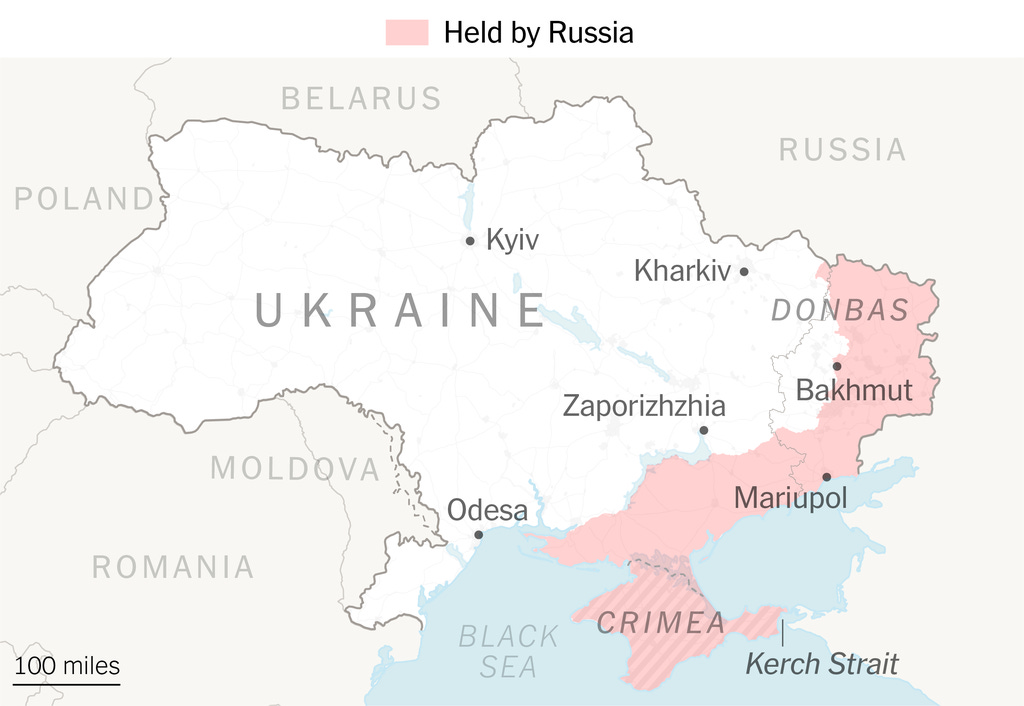
I liked this passage from the NYT article/newsletter: “The troops [of Ukraine] have learned a technique known as combined-arms warfare, in which different parts of the military work together to take territory. Tanks punch through enemy lines by rolling over trenches, for example, and infantry then spread out to hold the area.”
It sure sounds nice and clean. Tanks “punch through” and infantry “then spread out.” I’m sure glad the Russians have no tanks of their own, no anti-tank missiles, no machine guns, and no artillery.
Here’s another example from the NYT article of positive thinking and bloodless prose:
In the favorable scenario for Ukraine, a peace deal in which Russia is expelled from everywhere but Crimea and parts of the Donbas region would become plausible. On the flip side, a failed counteroffensive and an unbroken land bridge would provide Putin with a big psychological victory and a foundation from which to launch future attacks.
Only two scenarios? Either the Ukraine counteroffensive is a success, leading to a favorable peace deal, or it stalls, meaning victory for Russia and future Russian assaults? What about a wider war with Russia? Or a wildly successful attack that leads the Russians to deploy tactical nuclear weapons against it? Or an attack that Ukraine can’t sustain, leaving it vulnerable to Russian counterattacks in which Ukraine is convincingly defeated?
No matter what happens, we can count on at least two things as certain: more dead and wounded Russians and Ukrainians, and more profits for all those arms merchants providing weaponry to Ukraine, much of it paid for by American taxpayers, whether they know it or not.
Nowhere in this NYT newsletter is anything mentioned about the human costs of this much-anticipated Ukrainian counteroffensive. There’s only one mention of losses, and that comes with Russia:
Experts have compared the war’s recent months to World War I, with both sides dug into trenches and neither making much progress. Russia lost tens of thousands of troops this year merely to capture Bakhmut, a marginal city in the Donbas.
I’m glad Ukraine “lost” no troops in defending that “marginal city in the Donbas.” And who’s to say which city is “marginal” and which isn’t?
I’ve heard the NYT described as “liberal,” but when it comes to war, the NYT is a bloodthirsty cheerleader. Perhaps that’s the new face of liberalism in America today.
 Bracing Views
Thank you for this perspective. I greatly appreciated learning, from your quote of the NYT, *”**The troops [of Ukraine] have learned a technique known as combined-arms warfare, in which different parts of the military work together to take territory.”*
Imagine that: after years of being trained by NATO forces and a year of combat so intense that the American general Christopher G. Cavoli expressed concern that not even the United States was capable of making war with Russia*, the troops [of Ukraine] have learned about combined-arms warfare. How far the Times has fallen.
*see Cavoli’s statement in the video excerpt below, spliced into a discussion between Andrew Napolitano and Scott Ritter. Cavoli says, in the excerpt shown: “This (war) is very different from the last 20 years, where we’ve deployed smallish groups of people to conduct limited activities on a rotational schedule. Everything was quite predictable and containable. The idea of large scale war like we’re seeing in Ukraine just requires different levels of readiness, it requires different force models for preparation, it requires different tactics and operational art. It requires different pieces of kit. We have a very strong basis for it, as you know we’ve been exercising it for many years, but really, to return it as the focus of the alliance, we’ll bring some changes . . . ”
Link: https://www.youtube.com/watch?v=24oujaTMvqk
Thanks again for posting.
Jim
LikeLiked by 1 person
Thanks for sharing that, Jim.
General Cavoli nailed it. This war is very similar to the one America used to plan to fight until the USSR disintegrated back in 1991.
Fortunately by that time ~ courtesy of our boy Saddam’s problem with Kuwait ~ we had established a full-time combat-ready presence in the Middle East, something we had been trying to do since World War II, if not World War I.
Taking up residence in Islam’s Holiest Nation and Land ~ along with our treatment of post-Kuwait Iraq ~ planted the seed for what would follow ten years later on 9/11. And for all that has followed in the twenty-plus years since.
Thanks again, and have a Great day. ~ jeff
LikeLike
Metaphorical Militarist Animism
The condom and the jellyfish
met floating side-by-side.
One came down with the river while
one swam in with the tide.
There in the estuary they
had matters to decide.
It seems that by this stream which flows
thru Washington, D. C.
A black hole having five sides eats
whatever it can see
supplied by all three branches of
U.S. Bureaucracy.
The condom said it knew of “love”
at least the kind for sale,
consumed by those Americans
who play at war, then fail.
Ejaculation premature:
a timeless tawdry tale.
The jellyfish found this absurd:
that love would find success.
For it had sailed upon the sea
and knew vast carelessness:
The waves, like War, could hardly care
who made a bloody mess.
“How many sides has Gog?” some ask
who bask in Revelation.
Apocalypse or End of Days
requires intense fixation:
acute self-neutered intellect;
Inquisitive Castration.
The Jellyfish at last swam on
Upstream against the flow.
The condom let the current tell
it when and where to go:
a symbol of America
which has no wish to know.
Michael Murry, “The Misfortune Teller,” Copyright © 2021
LikeLiked by 1 person